What Is Classical Pilates (And Where to Find It in Port St. Lucie)
Key Takeaways
- Classical Pilates is the original movement system developed by Joseph Pilates, taught in a specific sequence using traditional apparatus.
- It differs from contemporary Pilates in its adherence to the original order, equipment, and teaching lineage.
- The full Classical method includes the Reformer, Mat, Cadillac, Wunda Chair, Ladder Barrel, Spine Corrector, and other apparatus, each serving a specific purpose within the system.
- Instructor training and lineage matter. A qualified Classical teacher has been trained within a traceable line back to the original method.
- If you are looking for authentic Classical Pilates in Port St. Lucie and the Treasure Coast, Lucie Lemon Pilates is a boutique studio offering exactly that, led by Master Teacher Deb Lemon.
If you have searched for Pilates in Port St. Lucie, you have probably noticed that the word “Pilates” gets used for a lot of different things. Some studios offer reformer fitness classes. Others blend mat work with yoga or resistance training. A handful offer what they call “Classical Pilates.” And it is perfectly reasonable to wonder: what does that actually mean, and does the difference matter?
It does matter quite a bit. Classical Pilates refers specifically to the original method created by Joseph Pilates, taught in the order he designed, on the equipment he built, and passed down through instructors who trained within that same tradition. It is not a style preference or a marketing label. It is a distinct system with a specific history and a very clear way of doing things.
This article explains what Classical Pilates actually is, how it differs from the broader Pilates landscape, what to look for when you are trying to find the real thing on the Treasure Coast, and what Lucie Lemon Pilates offers in Port St. Lucie.
What Did Joseph Pilates Actually Create
Joseph Pilates was born in Germany in 1883. As a child, he dealt with serious health challenges, including asthma and rickets, which pushed him toward an unusually deep study of how the human body moves and heals. His path led him through gymnastics, boxing, and anatomy before he arrived in New York City in the 1920s and opened a studio that would eventually change how millions of people move.
He called his method “Contrology.” The name itself tells you something important: the emphasis was on control, not just movement. He designed a system of exercises to strengthen the core (which he called the “powerhouse,” covering the abdomen, lower back, hips, and upper thighs), improve posture, and create genuine coordination between the body and mind. No muscle worked in isolation. Every exercise was part of a deliberate architecture.
His studio attracted dancers, athletes, and performers. George Balanchine and Martha Graham both sent their students there. What those early clients found was not just a workout but a method, one that took time, skill, and consistent practice to develop properly. In 1945 he codified the method’s mat work in his book “Return to Life Through Contrology,” documenting the original 34 exercises along with his principles of breath, posture, and spinal health. It remains one of the most direct sources of what Classical Pilates actually is in its founder’s own words.
When Pilates died in 1967, he left behind both a system and a group of students he had trained personally. These first-generation teachers, sometimes called the Pilates Elders, carried the work forward. Among them, Romana Kryzanowska is widely credited with doing the most to preserve the original method faithfully, training second-generation teachers who in turn trained the instructors practicing Classical Pilates today.
That chain of teaching is what Classical Pilates lineage means. It is how the original system stays intact across generations.
How Is Classical Pilates Different from What You See at Most Studios
This is where things get practical for anyone trying to find quality instruction in Port St. Lucie or anywhere else.
Contemporary Pilates, which is what most large fitness studios offer, uses the same foundational principles Pilates established: breath, control, precision, and core engagement.
But it also modifies exercises, changes sequences, introduces props that were never part of the original system (foam rollers, resistance bands, stability balls), and adapts the method based on modern physical therapy and sports science. That is not necessarily wrong. Contemporary Pilates has helped a lot of people. But it is a different thing.
The key differences come down to three areas.
The sequence
Classical Pilates follows the order Joseph Pilates established. Each exercise prepares the body for the next. The sequence is not arbitrary; it has a logic to it that warms the body progressively, challenges it appropriately, and then brings it down. Contemporary Pilates classes typically allow instructors to mix and match exercises based on their own judgment or the preferences of the class.
The apparatus
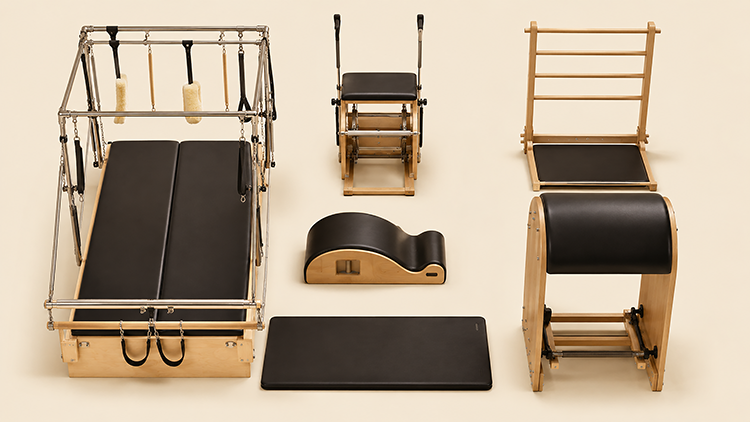
The Classical method uses the full suite of equipment Pilates designed: the Reformer, Mat, Cadillac (also called the Trapeze Table), Wunda Chair, Ladder Barrel, Spine Corrector, and others. Each piece of apparatus addresses the body in a specific way.
The Reformer is the foundation, offering spring resistance across a wide range of positions and movements. The Cadillac adds variety and is particularly useful for deepening the work and refining technique. The Wunda Chair challenges balance, stability, and strength in a way that nothing else replicates. The barrels work on spinal flexibility and extension.
A studio that has only reformers is teaching reformer fitness, which may be valuable, but it is not the complete Classical system.
The teaching lineage
Classical instructors are trained within a direct line back to the original method. This matters because the system contains nuances that cannot be learned from a manual alone. How to read a body. How to sequence a session for an individual client. When to progress and when to stay with a fundamental. These things are passed down through teaching relationships, apprenticeships, and hours of supervised practice.
Contemporary programs can produce excellent teachers. But a Classical studio should be able to tell you who trained their instructors and how that training connects back to the original method.
Does the Difference Actually Matter for Results
For many people, it does.
The Classical approach treats the repertoire as a complete system. Every exercise has a place in the whole. When a qualified Classical teacher programs your sessions, they are drawing on that entire architecture: using the order to support your body, selecting apparatus work that addresses your specific needs, and progressing you through the system in a way that creates lasting change rather than temporary effort.
That outcome aligns with what the research shows. A 2024 systematic review published in PubMed covering 783 participants across 13 studies found that Pilates provides meaningful evidence for improving postural disorders affecting the cervical, thoracic, and lumbar spine, with researchers suggesting it holds significant potential as a complementary therapy.
This is especially meaningful for people who have tried general fitness reformer classes and felt something was missing. The classes were fine. The movements made sense. But there was no clear sense of progression, no feeling of being seen as an individual, and no deepening understanding of the work over time.
Classical Pilates, practiced well with a qualified teacher, tends to feel different. The sessions have coherence. You are learning a system, not just completing a workout. And because the method asks you to develop genuine control over how your body moves, the results tend to be durable in ways that high-volume fitness classes often are not.
That said, Classical Pilates is not the right fit for everyone. If you want a fast-paced group reformer fitness class, a Classical boutique studio may not be what you are looking for. Classical instruction typically involves a more careful, individualized approach, smaller class sizes, and a longer timeline for developing the work.
What Should You Look for in a Classical Pilates Studio on the Treasure Coast
If you are looking specifically for Classical Pilates in Port St. Lucie, Stuart, Jensen Beach, or elsewhere on the Treasure Coast, here are a few things worth asking about.
Full apparatus
A genuine Classical studio has the complete range of traditional equipment. If a studio offers only reformers, it is not offering the full Classical method.
Instructor training and lineage
Ask where the instructors were trained and whether their training was Classical or contemporary. A serious Classical program requires significant hours of hands-on instruction, observation, and apprenticeship under a qualified teacher. Weekend certification courses are common in the broader fitness industry; comprehensive Classical training is something different.
Small class sizes
Classical Pilates instruction depends on the teacher being able to see you clearly, offer corrections, and adapt the session to how your body is responding. Large classes make that impossible.
New client protocols
A studio that takes Classical instruction seriously will want to understand your body and movement history before placing you in a group class. At Lucie Lemon Pilates, every new client begins with two introductory private sessions before joining group reformer classes. This is not a formality; it is how the studio ensures every person receives genuinely appropriate instruction from the start.
Teacher with a verifiable background
You do not need to demand credentials at the door, but it is reasonable to look at the studio’s about page, understand who is teaching, and see whether they can speak clearly about their training background.
Classical Pilates in Port St. Lucie: Lucie Lemon Pilates
Lucie Lemon Pilates is a boutique Classical Pilates studio located at 145 NW Central Parkway, Suite 104, in Port St. Lucie. The studio is led by Master Teacher Deb Lemon and offers small-group reformer classes, private sessions, and a comprehensive teacher training program rooted in the authentic Joseph Pilates method.
The studio works with the full Classical apparatus: Reformer, Mat, Cadillac, Wunda Chair, Ladder Barrel, and Spine Corrector. Classes are intentionally small so that every client receives real attention, meaningful corrections, and a session that reflects their individual progress rather than a generic group experience.
Clients come to Lucie Lemon Pilates from across the Treasure Coast, including Stuart, Palm City, Jensen Beach, Fort Pierce, and Vero Beach. The studio also welcomes seasonal residents and visitors who want to maintain their Classical Pilates practice while spending time on Florida’s Treasure Coast.
Final Takeaway
Classical Pilates is not a trend or a style variation. It is the original system, intact and taught as its founder intended. For people who want more than a reformer fitness class, and who are genuinely curious about what disciplined, intelligent movement can do for their body over time, finding a qualified Classical studio is worth the effort. The difference between a well-taught Classical session and a generic group class is not subtle once you have experienced both.
Finally
If you are looking for Classical Pilates in Port St. Lucie or the broader Treasure Coast area, Lucie Lemon Pilates offers exactly what this article describes: authentic instruction, full apparatus, small class sizes, and a teaching environment led by Master Teacher Deb Lemon.
Whether you are brand new to Pilates, a returning practitioner looking for the real thing, or someone exploring teacher training in the Classical tradition, the studio is worth your time to explore. You can learn more and get started at Lucie Lemon Pilates.
FAQs
Is Classical Pilates harder than regular Pilates?
That depends on what you mean by “harder.” The Classical method is precise, deliberate, and asks you to develop genuine control rather than just complete movements. Some people find that more demanding than high-repetition group fitness classes. Others find it more sustainable, because the work is built around what your body can actually do, progressed carefully by a teacher who is watching you closely.
Do I need any Pilates experience to start at a Classical studio?
No. Classical Pilates is a complete system designed to be learned from the beginning. Most Classical studios, including Lucie Lemon Pilates, begin new clients with private sessions specifically to introduce the fundamentals before group work. You do not need to arrive already knowing how to use a reformer.
Is Classical Pilates appropriate for people recovering from injury or with physical limitations?
Classical Pilates has been used with people of all physical conditions since its origins. Joseph Pilates himself developed the work partly out of his own experience rehabilitating others. That said, working with any physical limitation requires a genuinely qualified teacher who can adapt the method appropriately, not a group class with a high client-to-teacher ratio. Private sessions with a knowledgeable Classical instructor are the most responsible starting point if you have significant physical considerations. Always consult your physician before starting a new exercise program if you have existing health conditions.